Piles Of Proofs
A few suggestions on making proof prints


Unexpected Opening In Our Portfolio Workshop
Before moving on to today’s topic of proof printing I wanted to make the community aware that we have an opening in our November 2025 portfolio workshop. Typically we run one of these every year but due to demand we opened two. Both filled up within a week of our announcing them earlier in the year. Turns out we screwed up and double counted someone that was on our waiting list or something like that…
We’re reaching out to the Paper Arts community to see if anyone would like the spot in our premiere workshop this coming November 14th through November 16th (Friday through Sunday). You can get more information and reserve a seat on Les’ website. Feel free to contact us for more information, we’ll be glad to see if this experience is right for you. On with the Show…
Proofing
We make piles of proofs. I’d venture to say we are the top ten proof printers that exist. I have no idea if that’s really the case. It certainly feels like we make a mountain of proof prints. We make more proofs during our workshops than most individual photographers make total prints. We insist on making proofs for our participants prior to going to large prints. We insist on this ourselves unless we’ve already landed on the rendition we prefer and have printed a particular image as a final print in the past.
We also make proofs on paper we know very, very well prior to committing to extremely expensive materials. Not perfect but if you have a standard proofing material in the same general neighborhood and you have reasonable experience with the more expensive material it is far better than guesswork. The secret to good proofs is to standardize on one or two papers as your default go-to papers. We have two standard papers. One glossy or semi-gloss which is Moab Juniper Baryta. The other and most used standard is a mat paper, Moab Entrada Natural 190.
It might seem like proofing is a waste of money but it’s an order of magnitude less money than ink and paper for a large print. Think in square inches, that’s the way cost runs for paper and ink. An A3+ or A2 print is far, far more expensive than a small print. As you gain experience you’ll make fewer prints. We don’t bother making a second proof if we are “sure” and we only make a small tweak to contrast or shadow rendering. We might make a second proof if we’re not sure which rendering we prefer but usually we’ll keep both in view for a week or so to decide. We’ll also make a second or third proof if we are going HUGE. That proof will be a small section out of the whole image to evaluate detail at a particular magnification if it’s a new image (Photoshop is easier to do that than Lightroom).
A few tips to consider
Consider making proofs count. In other words, don’t print borderless unless you have a good reason to (like those small sections of very large prints). Leave some white space so the print looks nice. You may want to use it for a small portfolio or a gift. On letter and A4 6in x 9in images look great!
If you’re making A LOT of proofs of unknown images put multiple images on one sheet. We do this all the time, especially for book projects, exhibitions of new work, etc. Get a good paper cutter and cut them, it’s a far better experience curating your work than doing it on the computer…
Here’s an open secret… We love Moab Entrada Natural but there’s more to it than just being a great cotton mat paper. All of it is double sided, no special versions all of it in both 190 and 300gsm weights. So think about using double sized paper than you can get two proofs from instead of one. There are other double-sided mat papers but usually they are a special version and cost a bit more.
Having that go-to paper as a standard will make paper comparisons and tests far, far more meaningful and as a bonus you’ll find your taste and skill at matching image to a paper than enhances the presentation improve without even realizing it’s happening.
As I’ve mentioned before, we do proofs using known images after every software update to our environment to ensure it’s preforming to a known standard. You should to before you realize something is very wrong a dozen prints into a problem you didn’t notice on new work.
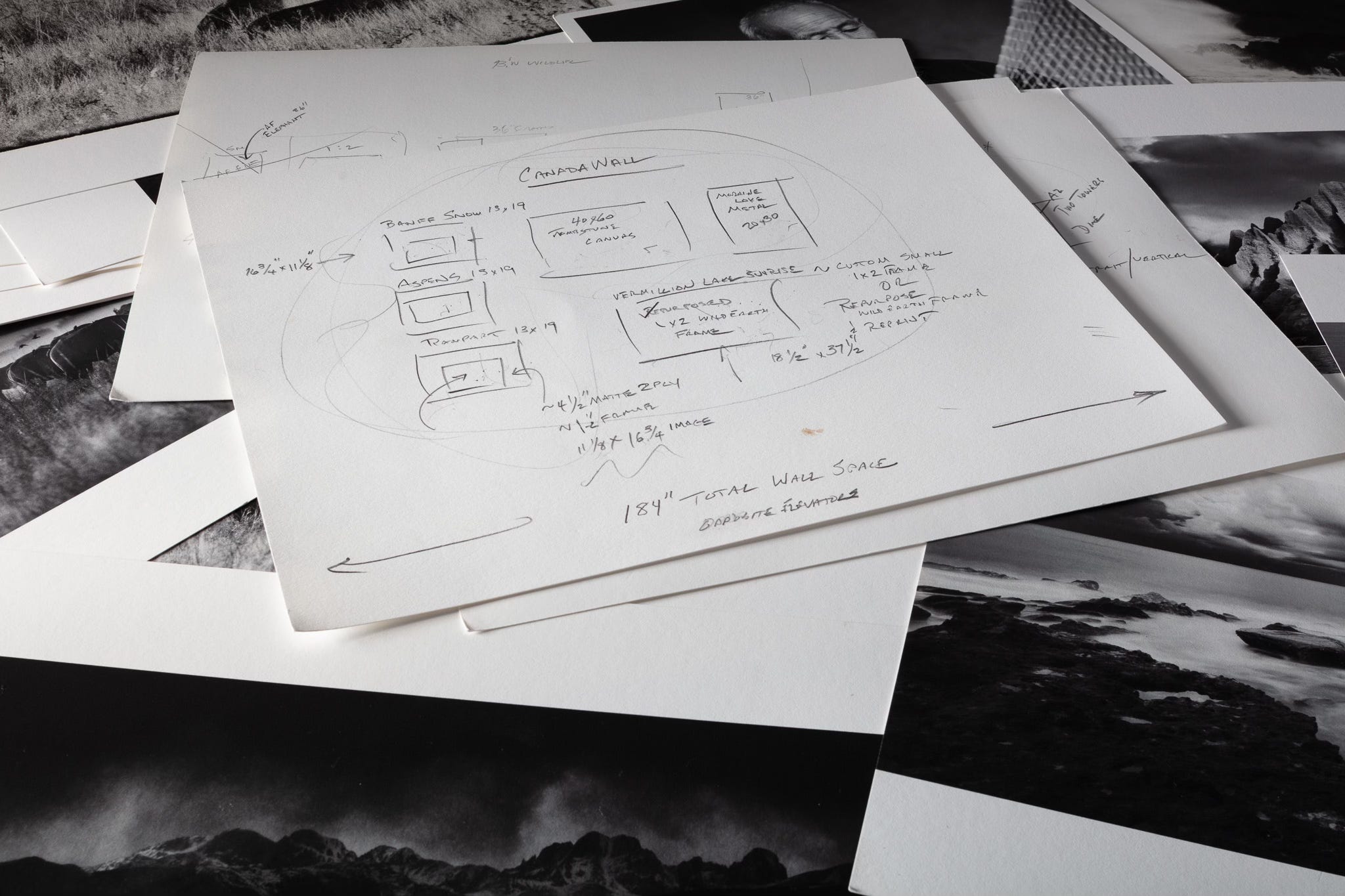
Lastly recycle it. I am sure all of you will recycle it in the recycle bin way but before you even think about that, use it for notes, scratch paper, pretty much anything you’d normally use any paper for. We do, some of our best work is recorded on the back of proofs that were either bad, were not gift/display worthy, were on single sided-paper, or were those maximum magnification samples. The small pile of drawings pictured above is the layout of a retrospective exhibition Les is having in late September. More on that later but a heck of a lot of thinking is done on the back of old proof-prints in our studio.
Thanks for this; it should be standard practice for all photographers but some just go straight to printing big.